Maratha History - मराठा इतिहास
A chronology of events linked to the history of the Maratha Empire
मराठा साम्राज्याच्या इतिहासाशी संबंधित घटनांचा कालानुक्रम
The last political and military hegemony over India before the British Raj was that of the Marathas (and not of the Mughals as we are usually led to believe). The Maratha Empire was the dominant political and military force in the Indian subcontinent for the best part of a century, from the 1730s to the 1810s. Until it crumbled in the face of European greed and imperialism, the Maratha Empire was the best placed entity to combine the country into a united political entity - 'Swarajya'.
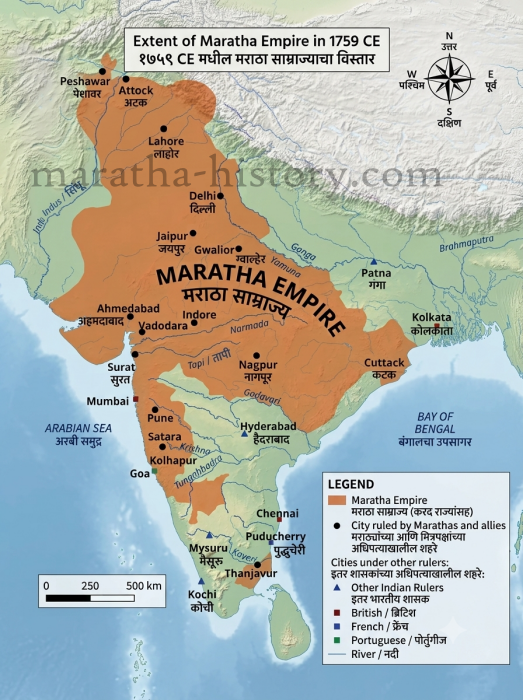
ब्रिटिश राजवटीपूर्वी भारतावरील शेवटची राजकीय आणि लष्करी सत्ता मराठ्यांची होती (जसे सामान्यतः शिकवले जाते त्याप्रमाणे मुघलांची नाही). १७३० च्या दशकापासून ते १८१० च्या दशकापर्यंत, सुमारे एक शतक मराठा साम्राज्य भारतीय उपखंडातील प्रमुख राजकीय आणि लष्करी शक्ती होते. युरोपीय लालसा आणि साम्राज्यवादामुळे त्याचा अस्त होईपर्यंत, देशाला एकात्मिक राजकीय घटकात -'स्वराज्य'- एकत्र आणण्यासाठी मराठा साम्राज्य हीच सर्वात योग्य सत्ता होती.
A (very) brief outline of Maratha History
The Maratha Empire came into being with the coronation of Shivaji Raje Bhonsle as Chhatrapati in 1674CE, in a small hilly tract of land in western India. After surviving near annihilation in the following decades, as the Mughals attempted to quell the ‘insurrection’, the Maratha power began to stabilize and consolidate from the 1710s, parallel to the crumbling of Mughal power. The Bhat family came to prominence with Balaji Vishwanath Bhat appointed as Peshwa (or Prime Minister) by the Chhatrapati Shahu I (Shivaji’s grandson) in 1713CE, and his son Bajirao and grandson Balaji (Nanasaheb) rapidly expanded the Maratha dominions, and by 1760CE Maratha control stretched from Lahore and Attock in the north-west and Odisha in the east, to Thanjavur in the south.
A disastrous defeat in the third battle of Panipat in 1761CE checked the expansion and led to internal turmoil (By then the British had already gotten a foothold in Bengal with the treacherous victory in the Battle of Plassey in 1757CE). A resurrection and stabilization came in the 1770s, led by the great general Mahadji Shinde of Gwalior. The Maratha Empire also staved off the first serious confrontation with the British in the first Anglo-Maratha war which ended inconclusively in 1782CE. However, the death of Mahadji Shinde and Peshwa Madhavrao led to a series of intrigues and internal power-mongering. The Peshwa Bajirao II unfortunately chose to request British intervention again, triggering the second Anglo-Maratha war in 1802CE. Taking advantage of their internal disunity, the British were able to defeat the Maratha chiefs piece-meal, and by 1805CE the war ended with the British signing subsidiary alliances with the Peshwa and all four major Maratha chiefs separately, dismembering the Maratha empire.
An uneasy peace lasted for another decade, but smarting under increasing British intervention and control, an insurrection flared again in 1817CE, and the Peshwa Bajirao II attempted to again raise a united Maratha front against the British, starting the Third Anglo-Maratha war. The British however were able again to defeat the separate Maratha resistances, with victory over the Peshwe and the major Maratha houses (Holkar, Shinde, Bhonsle and Gaekwad) individually, leaving the British EIC in direct control of much of the Indian subcontinent.
The Maratha Empire thus came to an end in 1818CE, 144 years after the coronation of Shivaji Maharaj as Chhatrapati. The Peshwai was abolished, Bajirao II was exiled with a pension to Bithoor near Kanpur. The seat of the Chhatrapati was also converted into an independent subsidiary state with the title 'King of Satara'. Of the great Maratha houses, Shinde (Scindia) of Gwalior, Holkar of Indore, Gaekwad of Baroda and the Chhatrapati rival claim house of Bhonsle of Kolhapur survived as princely states in the British Raj until Indian independence in 1947CE.
मराठा इतिहासाची (अतिशय) संक्षिप्त रूपरेषा
१६७४ साली पश्चिम भारतातील एका लहान डोंगराळ प्रदेशात शिवाजी राजे भोसले यांचा छत्रपती म्हणून राज्याभिषेक झाल्यावर मराठा साम्राज्याची स्थापना झाली. पुढील दशकांमध्ये मुघलांनी हे 'बंड' दडपण्याचा प्रयत्न केल्यामुळे जवळजवळ नामशेष होण्याच्या परिस्थितीतून वाचल्यानंतर, १७१० च्या दशकापासून मुघल सत्तेच्या ऱ्हासासोबतच मराठा सत्ता स्थिर आणि मजबूत होऊ लागली. छत्रपती शाहू पहिले (शिवाजी महाराजांचे नातू) यांनी १७१३ साली बाळाजी विश्वनाथ भट यांची पेशवा (किंवा पंतप्रधान) म्हणून नियुक्ती केल्यावर भट घराणे प्रसिद्धीस आले. त्यांचे पुत्र बाजीराव आणि नातू बाळाजी (नानासाहेब) यांनी मराठा राज्याचा वेगाने विस्तार केला आणि १७६० पर्यंत मराठा नियंत्रण वायव्येस लाहोर आणि अटॉकपासून पूर्वेस ओडिशापर्यंत आणि दक्षिणेस तंजावरपर्यंत पसरले होते.
१७६१ मध्ये पानिपतच्या तिसऱ्या लढाईतील विनाशकारी पराभवाने विस्ताराला खीळ घातली आणि अंतर्गत गोंधळ निर्माण झाला (तोपर्यंत ब्रिटिशांनी १७५७ मध्ये प्लासीच्या लढाईतील विश्वासघाताने मिळवलेल्या विजयामुळे बंगालमध्ये आपले पाय रोवले होते). १७७० च्या दशकात ग्वाल्हेरचे महान सेनापती महादजी शिंदे यांच्या नेतृत्वाखाली मराठा साम्राज्याचे पुनरुत्थान आणि स्थिरीकरण झाले. मराठा साम्राज्याने पहिल्या इंग्रज-मराठा युद्धात ब्रिटिशांशी झालेल्या पहिल्या गंभीर संघर्षालाही तोंड दिले, जे १७८२ मध्ये अनिर्णितपणे संपले. तथापि, महादजी शिंदे आणि पेशवा माधवराव यांच्या मृत्यूनंतर अनेक कटकारस्थाने आणि अंतर्गत सत्तासंघर्ष सुरू झाला. दुर्दैवाने पेशवा बाजीराव दुसऱ्याने पुन्हा ब्रिटिश हस्तक्षेपाची मागणी करण्याचा निर्णय घेतला, ज्यामुळे १८०२ मध्ये दुसरे इंग्रज-मराठा युद्ध सुरू झाले. त्यांच्या अंतर्गत फुटीचा फायदा घेऊन, ब्रिटिशांनी मराठा सरदारांना एकेक करून पराभूत केले आणि १८०५ पर्यंत हे युद्ध संपले. ब्रिटिशांनी पेशवा आणि चारही प्रमुख मराठा सरदारांशी स्वतंत्रपणे तैनाती फौजेचे करार करून मराठा साम्राज्याचे तुकडे केले.
पुढील दशकभर एक अशांत शांतता टिकून राहिली, परंतु वाढत्या ब्रिटिश हस्तक्षेप आणि नियंत्रणामुळे संतप्त होऊन १८१७ मध्ये पुन्हा बंड भडकले आणि पेशवा बाजीराव दुसऱ्याने ब्रिटिशांविरुद्ध पुन्हा एकसंध मराठा आघाडी उभारण्याचा प्रयत्न केला, ज्यामुळे तिसरे इंग्रज-मराठा युद्ध सुरू झाले. तथापि, इंग्रजांनी पेशवे आणि प्रमुख मराठा घराण्यांचा (होळकर, शिंदे, भोसले आणि गायकवाड) एकेक करून पराभव करत, स्वतंत्र मराठा प्रतिकारांना पुन्हा एकदा मोडून काढले, ज्यामुळे ब्रिटिश ईस्ट इंडिया कंपनीचे भारतीय उपखंडाच्या मोठ्या भागावर थेट नियंत्रण आले.
अशा प्रकारे, छत्रपती शिवाजी महाराजांच्या राज्याभिषेकानंतर १४४ वर्षांनी, इ.स. १८१८ मध्ये मराठा साम्राज्याचा अंत झाला. पेशवाई संपुष्टात आणली गेली, बाजीराव दुसऱ्याला पेन्शन देऊन कानपूरजवळील बिठूर येथे हद्दपार करण्यात आले. छत्रपतींचे आसन देखील 'सातारा नरेश' या पदवीसह एका स्वतंत्र मांडलिक राज्यात रूपांतरित करण्यात आले. ग्वाल्हेरचे शिंदे (सिंधिया), इंदूरचे होळकर, बडोद्याचे गायकवाड आणि छत्रपतींच्या गादीवर हक्क सांगणारे कोल्हापूरचे भोसले ही प्रमुख मराठा घराणी १९४७ मध्ये भारताला स्वातंत्र्य मिळेपर्यंत ब्रिटिश राजवटीत संस्थानांच्या रूपात टिकून राहिली.